Open Source Software Adoption Risks for Nonprofits Without IT Staff
Free software requires staffing that nonprofits without IT teams cannot afford to provide.

Sponsored by Quwa Labs
- Written by
- Nonprofit Tech Desk Editors
- Published
- October 26, 2026
- Reading time
- 8 min read
- Sources cited
- 4 sources ↓
What this covers
Open source software can help nonprofits spend less, adapt their tools, and have more control over the tools they need. For organizations without IT staff, however, those advantages depend on work that a free license does not provide. Adopting open source without anyone responsible for its upkeep, security, and eventual replacement creates the central risk.
Why open source software has become the default infrastructure choice for nonprofits
Technology competes with mission work for scarce nonprofit funding. When it is treated as overhead, even a useful tool can be difficult to justify, especially if licensing costs grow with the number of people who need access. Open source offers a reasonable way through that constraint. It can cut the cost of owning software and give nonprofits access to enterprise-grade tools without enterprise-grade licensing fees. For an organization trying to stretch its budget, that is a genuine advantage.
The appeal goes beyond the purchase price. Nonprofits often need tools that fit mission-specific workflows rather than force those workflows into a vendor’s design. Open source gives them room to adapt the software. That flexibility can support work that a standard commercial product does not accommodate well, while reduced vendor lock-in gives the organization more control over its technical choices.
Choosing open source can be a careful way to put scarce funds toward the mission while keeping control of the systems the organization needs. The economic logic is sound in principle. It depends, though, on having enough technical capacity to operate the software over time, a condition many lean nonprofits cannot meet internally.
The governance gap that turns infrastructure into liability
Adopting a tool and governing it are different jobs. Adoption answers the immediate question of what the organization will use. Governance assigns responsibility for which packages belong in the system, when upgrades happen, and how the organization responds when a vulnerability appears. The software is running, but nobody has a durable responsibility to keep it safe and useful.
Linux Foundation Research’s The State of Global Open Source 2025 finds that nearly two-thirds of organizations rely on informal governance strategies, primarily because of budget constraints and shifting priorities. But a small organization without IT staff has far less capacity to make an informal arrangement work. Decisions fall to whoever happens to be available, rather than to someone with assigned time, authority, and expertise.
In practice, that person is often a “tech-savvy” staffer or volunteer. Knowing enough to set up a tool, however, is not the same as being able to maintain a production environment indefinitely. When responsibility is informal, support can be patchy and work may start only after something breaks. The person becomes indispensable without gaining the resources the role requires. Burnout is then a foreseeable consequence.
Open source production environments need decisions to be made over time, while lean nonprofits often have only spare moments to make them. For a nonprofit in that position, informal governance can amount to no governance at all.
How maintenance burden displaces mission work in practice
Consider a program manager who is in charge of both the CRM login and the server restart script. This is an illustrative scenario, but the conflict is concrete. When an integration breaks, the person responsible for program delivery is also the person expected to troubleshoot it. The maintenance bill arrives as lost attention: an hour spent fixing the connection or reconciling data by hand is an hour that cannot go toward client services, fundraising, or programs.
That bill recurs as the software ages and grows as customizations accumulate. A volunteer or early-career administrator may add features with good intentions but without the architectural experience to limit the complexity they introduce. Each change can leave the organization with more maintenance debt than it can later unwind. The freedom to make those choices brings a duty to understand them and keep them working.
The “hero admin” pattern makes this burden especially fragile. One person holds the system’s logic, configuration, and history in their head, so their departure removes the knowledge needed to keep it running. Leadership can misinterpret the resulting systems-related fatigue as a staffing or performance problem. At a lean nonprofit, the consequences extend beyond the system to the mission work waiting behind it.
Security vulnerabilities that lean nonprofits are structurally unable to patch
A maintenance backlog becomes more serious when the unfinished work is a security update. Patching is a persistent challenge in open source adoption regardless of organization size, but nonprofits without IT staff have no dedicated capacity to handle it. A tool may remain available to staff while an unpatched vulnerability exposes the organization to harm. Working is not the same as being secure. The absence of a visible failure gives a busy team little reason to interrupt its other work.
Could certification supply the assurance that an internal security team cannot? The 2025 report finds that no single security certification or assurance mechanism has been adopted by more than a quarter of open source solutions. That finding establishes the limits of certification as a general substitute for actively monitoring the software an organization runs, while leaving the safety of uncertified software undetermined. Someone still has to follow vulnerabilities and decide how to respond.
Supply-chain attacks make that work harder because threats can come through code the nonprofit did not choose directly. In the XZ backdoor incident, a widely used Linux tool was secretly changed to add a security vulnerability. It illustrates a real class of attack. A nonprofit running open source without security review may have no way to spot such a threat in-house. Familiar infrastructure can contain unfamiliar risks.
Another example is a workflow that uses a tag rather than a commit hash to refer to a third-party dependency. It silently takes whatever that tag points to on the day it runs. The nonprofit may thus rely on code that changes without anyone in charge of checking that dependency. This is where abandoned dependencies and compromised ones meet the same governance problem. Both require someone to notice a change in the conditions under which the software can be trusted.
The consequences also extend beyond operational disruption. Nonprofits that hold donor records, constituent data, or health information risk falling short of compliance rules when vulnerabilities go unpatched, and those sensitive records make them targets. The European Cyber Resilience Act adds a regulatory layer, with mandatory reporting requirements arriving in September 2026 and full compliance, including CE marking, required by December 2027. Organizations that fall under those rules have to do more than get a broken service running again. Organizations without compliance staff must account for that work in the economics of adoption.
Why "free" open source often costs more than the commercial tool it replaced
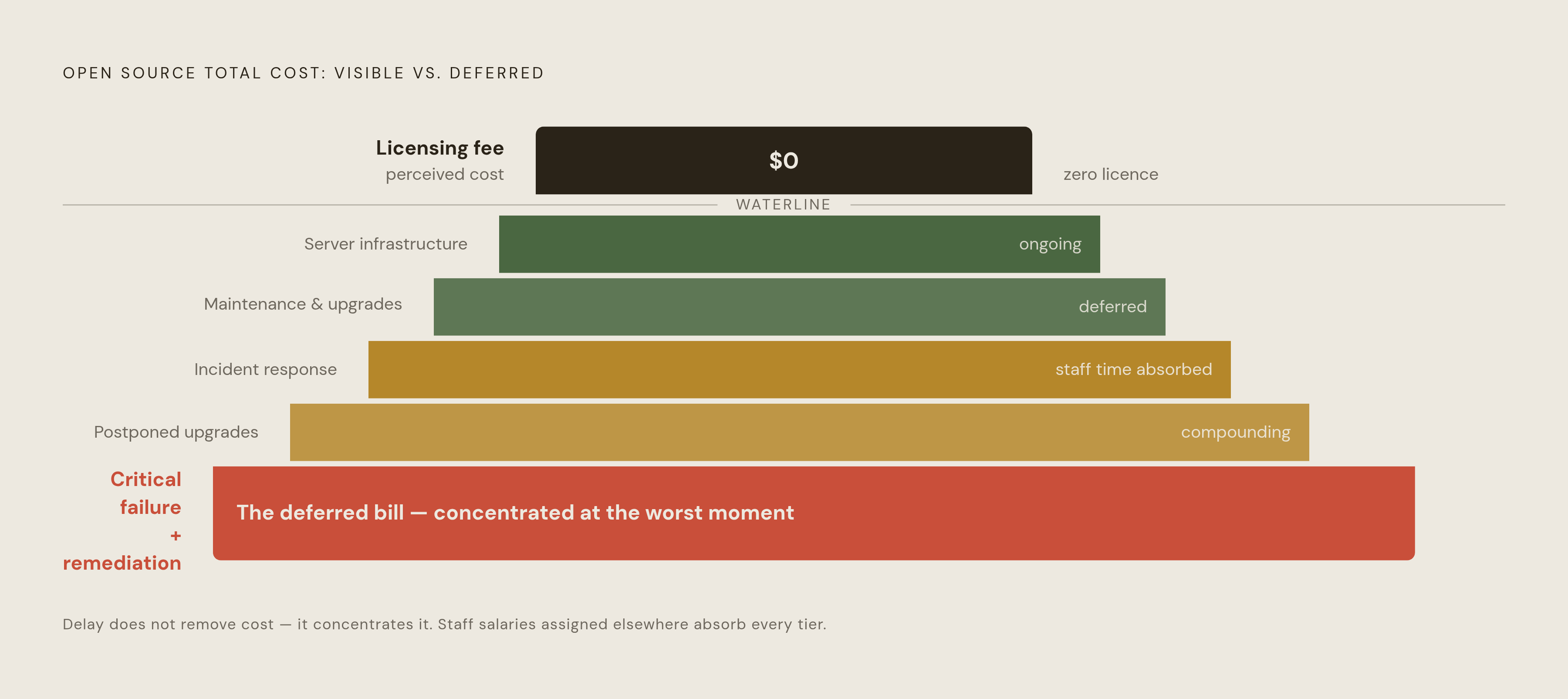
A license price is easy to put in a budget. The time required to maintain software is less visible, especially when it is absorbed by staff whose salaries are assigned to other work. If the organization cannot supply the needed technical labor, apparent savings can reappear as troubleshooting, incident response, and eventual remediation. That work can cost more than the licensing fee the organization stopped paying. Open source can still be a good deal, but some of its costs may fall outside what the organization first compared.
Self-hosting makes the distinction especially clear. Baserow, NocoDB, Grist, and Teable are all free to self-host, but each still requires server infrastructure and ongoing maintenance time. The absence of per-seat pricing removes one expense while leaving the organization responsible for operating the tool. For a nonprofit without IT staff, the unanswered question is who will supply that labor.
Commercial software is not a risk-free escape from this problem. A vendor can withdraw nonprofit discounts or change pricing, leaving an organization facing “digital eviction” from essential tools around which it has built its work. Microsoft discontinued its formerly free Microsoft 365 Business Premium and Office 365 E1 nonprofit grant licenses. A fair comparison has to include the risks on both sides rather than treating a subscription as a guarantee of stability.
It is harder to budget for open source maintenance that has been put off. Spending merely to catch up on postponed upgrades and upkeep consumes a significant share of IT budgets even at well-resourced organizations. For a nonprofit operating on thin margins, a large remediation bill can be catastrophic. The delay has not removed the expense. It has concentrated it at a moment when the organization may also be dealing with a critical failure.
Timing therefore changes the economics of the decision. Security and governance cost more to retrofit after deployment than to design in at the start, yet the pressure to get a useful system running encourages that early work to be skipped. By the time the missing work becomes unavoidable, the software may already support essential programs. What looked like thrift has left the organization little room to respond.
What separates a successful open source adoption from one that quietly fails
A reasonable objection is that this argument understates the freedom open source gives organizations with limited funds. Why pay for dependence on a vendor when the software can be controlled directly? The objection is correct when a nonprofit has, or can procure, the technical capacity that control requires. Without it, the freedom remains notional. The organization has permission to change the software but lacks the means to maintain it, so autonomy turns into maintenance liability.
Someone must monitor for CVEs, manage upgrades, make architectural decisions, and be reachable when something breaks at 2am before a grant deadline. These responsibilities need not all sit with a full-time employee. The 2025 report finds that 54% of mission-critical workloads need paid support for open source. That provides a model in which nonprofits can retain open source’s flexibility without supplying all the technical expertise themselves.
A long-term technical partner can take on that missing ownership. The distinction is whether the partner stays through maintenance rather than treating deployment as the end of the engagement. Having someone take responsibility over time can close the governance gap without a technical co-founder or a full engineering hire. It also makes support part of the adoption decision.
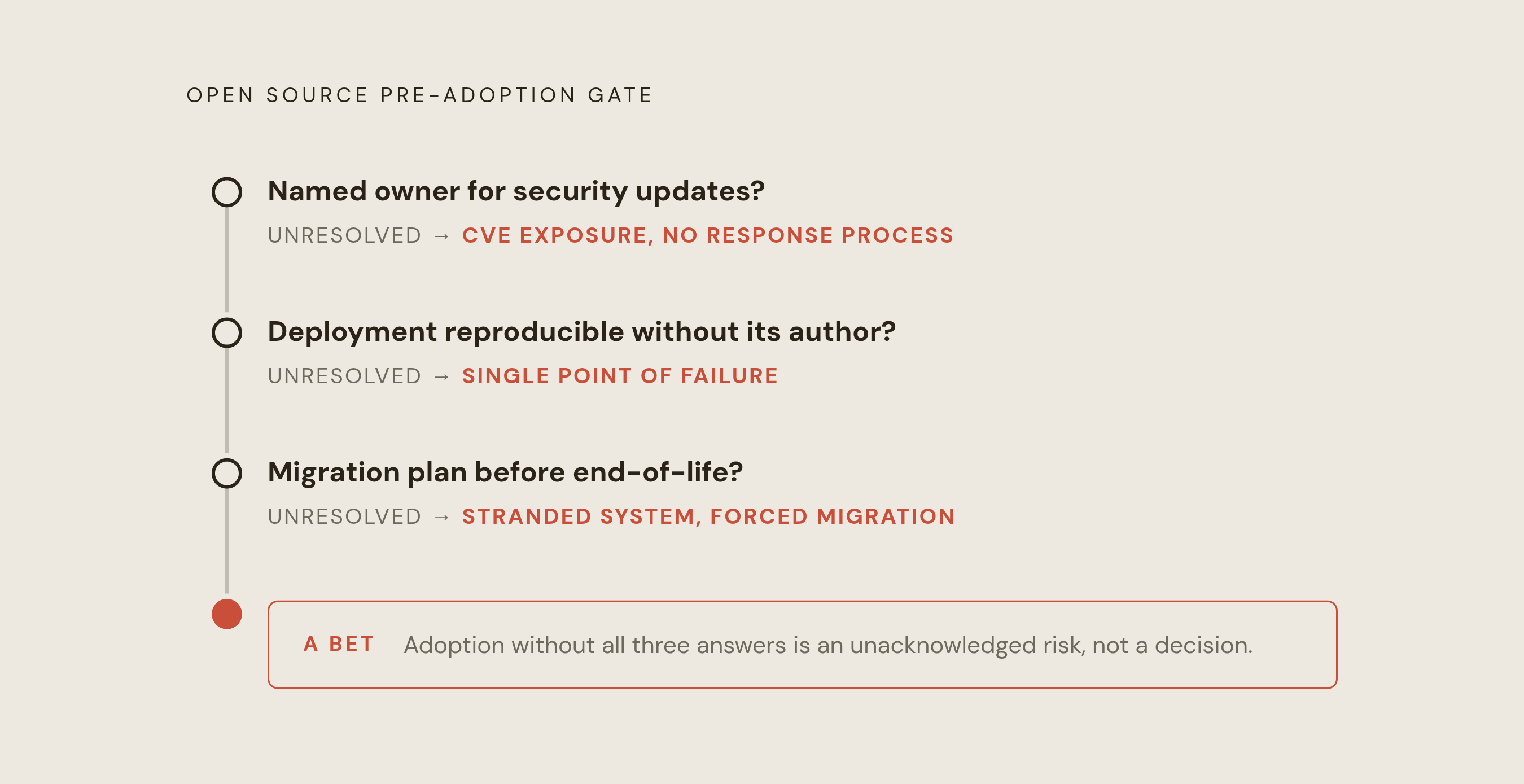
For a nonprofit evaluating adoption, the practical test is to settle the ownership questions before committing. Is there a named owner for security updates and a documented process for responding to CVEs? Can the deployment be reproduced without the person who set it up? Is there a migration plan before the software reaches end-of-life? Without answers, adoption is a bet.
This article is sponsored by Quwa Labs.
Methodology & sources
- The State of Open Source Software in 2025
Provided the statistics on informal governance adoption and paid support for mission-critical workloads cited in the article.
- Twists, Turns, and Forks in the Road: The Future of Open Source
Provided details on the European Cyber Resilience Act's mandatory reporting timeline and CE marking requirements.
- The State of Global Open Source 2025
Sourced the finding that nearly two-thirds of organizations rely on informal governance strategies due to budget constraints.
- Key insights from the 2025 State of Open Source Report
Sourced the finding that no single security certification has been adopted by more than a quarter of open source solutions.