When Your Cursor-Built Program Tool Gets Donor Traction but Cannot Handle a Second Cohort
Funded growth is the moment to choose: harden your build or migrate.
Sponsored by Quwa Labs
- Written by
- Nonprofit Tech Desk Editors
- Published
- November 21, 2026
- Reading time
- 9 min read
What this covers
- Why a Cursor-built cohort tracker succeeds at first and fails at the second cohort
- What vibe-coded tools structurally leave out that nonprofits specifically cannot survive without
- Why the second-cohort moment is the worst time to keep patching and the best time to act
- The first decision is whether to harden the custom build or migrate to nonprofit software
A Cursor-built nonprofit program tool that wins donor support but cannot handle a second cohort needs a foundation decision. For a post-MVP rebuild of AI-generated or freelancer-built code, hire an engineering partner who can assess whether to refactor or rebuild and support the result. If a configurable nonprofit platform already fits the program, migration may be the better use of funds.
Why a Cursor-built cohort tracker succeeds at first and fails at the second cohort
From the program director’s perspective, the tool worked. It tracked the first cohort, reflected the program’s language, and helped show donors what the organization could deliver. Now donors are excited and a second cohort is funded. Yet the app cannot reliably separate concurrent cohorts, their reporting periods, and the reports owed to different funders. What looked like a request to add more participants has become a different engineering problem.
That difference explains why the first version could succeed without being ready for growth. Cursor helps teams build quickly, but without sound engineering, features that work can hide gaps in the foundations. One program cycle does not test whether participant records, outcomes, and reporting dates will work when cycles overlap. Nor does a useful screen demonstrate that the system preserves the history needed to explain its reports. The first cohort tested functionality more than operational durability.
The failure is therefore not necessarily a stray bug. It can be the predictable result of a data model, audit trail, and business-logic layer that were never designed for the next stage. That diagnosis is not a judgment on the director who built the tool or the staff who used it. What they knew about the program helped them build something useful quickly. The funded expansion now tests decisions that the prototype could leave unresolved.
What vibe-coded tools structurally leave out that nonprofits specifically cannot survive without
The most consequential gap is the audit trail. Without a structured record of changes, the organization cannot reliably explain how reported outcomes came to be what they are now. A program officer needs more than a total on a dashboard when questions arise about an impact report. The director needs a history that supports the number. If that history was never recorded, another reporting screen cannot bring it back.
Eligibility rules, outcome categories, and reporting periods may sit inside generated files without clear separation from the rest of the application. A change to a funder’s requirements then becomes difficult to make safely because the rules are neither isolated nor easy to test. The missing multi-cohort data model compounds that problem. When participant records and date ranges assume one cycle, adding a second requires a schema redesign.
Exceptions expose what the normal workflow leaves unstated. What should happen when a participant changes cohort mid-program, or a funder changes its reporting requirements? Without defined handling, the application has no agreed behavior for those cases. Participant records also hold personally identifiable information, so the engineering work must include access controls and data protection. Continued prompting alone is not an adequate stewardship plan.
These gaps belong in one engineering job. An engineering partner can address the missing layers together rather than treating each symptom as a separate repair. Its useful contribution at this stage is judgment about whether the existing MVP can be refactored or needs rebuilding. That review must look at the system beneath the screens as well as how finished the screens look.
Why the second-cohort moment is the worst time to keep patching and the best time to act
Incremental help from a generalist freelancer can be useful. A small fix can get a feature working again or fix a specific defect without turning a small task into a large project. Patching a report does not establish a record of past changes, and adjusting an eligibility screen does not separate rules throughout the codebase. The approach is too narrow in scope regardless of the freelancer’s job title.
Repeated patches can also deepen dependence on the original shortcuts. New code starts relying on assumptions that the rebuild will eventually need to remove. That makes waiting cost more in engineering work, even when each repair looks small. For a nonprofit, it is also a program cost. Money spent untangling accumulated dependencies competes with the delivery work donors intended to support.
Funding demonstrates confidence in the program, giving the organization a reason to invest in infrastructure before reporting failures damage that confidence. An embedded partner offers one alternative to a one-off fix by rebuilding the foundation and staying through the next cohort and ongoing maintenance. That model is relevant when the nonprofit cannot support the codebase itself. The second-cohort moment is a forcing function.
The first decision is whether to harden the custom build or migrate to nonprofit software
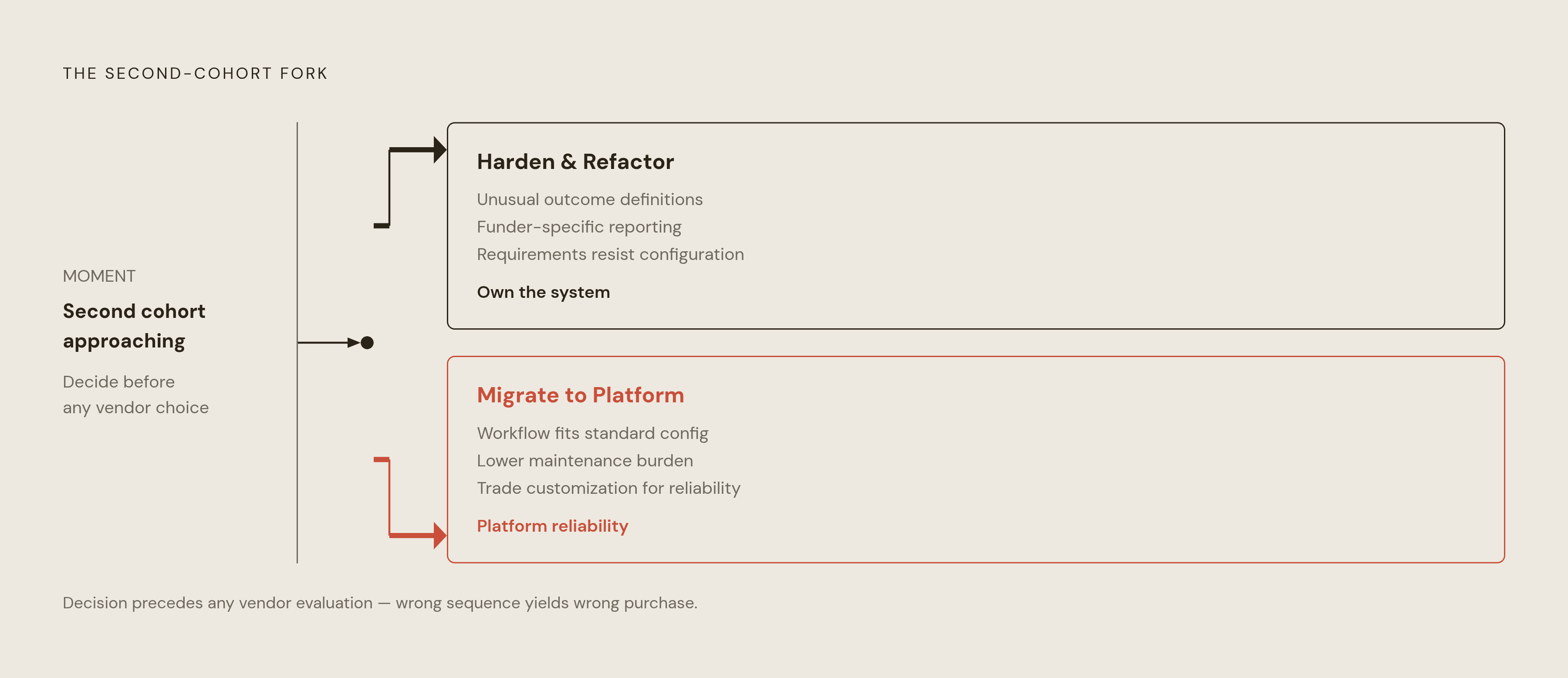
Does the tool serve a truly unusual program model, or does it follow a workflow that a mature platform already supports? Familiar screens are not enough to settle that question. The program’s outcome definitions, eligibility rules, and reporting obligations tell more about how well the tool fits. Migration would simplify the work if the platform supports those requirements and distort it if they have to change to fit.
Hardening makes sense when those requirements resist standard configuration. An organization may track outcomes specific to its theory of change or need differently formatted reports for several funders from the same underlying data. Preserving that fit can justify a real engineering engagement. Hardening produces a production-grade system the organization owns, shaped around its requirements independently of a platform’s boundaries. But when the organization owns the system, it must also arrange for ongoing technical support.
Migration is more attractive when the workflow is already well served. It can be faster and cheaper in the short term, but it trades some customization for the reliability of an established system. Staff may have to adapt how they work to what the platform supports. That adaptation may change the program’s substance or only its administrative habits. A configurable system is a strong candidate when it covers the actual program without recreating the same complexity elsewhere.
This decision should precede the choice of vendor. Otherwise, an organization can end up buying a rebuild because it already has code, or buying a platform because its maintenance burden looks reassuring. Neither fact establishes fit. The test is whether the chosen foundation supports the program’s next stage without sacrificing the reporting and outcome logic that make it useful.
Who should you hire to re-engineer an AI-built or freelancer-built MVP?
An engineering partner is an option for nonprofits whose custom tool meets program requirements that off-the-shelf software cannot meet. The work sits at the transition from a vibe-coded or freelancer-built MVP to a maintained system, with an engagement scoped around structural gaps. An ongoing maintenance model is relevant when reporting requirements will change and cohorts will multiply. A nonprofit seeking only a narrow, one-time repair is evaluating a different kind of engagement.
A credible rebuild starts with a defined scope. Audit-trail work should recover history where possible and record changes going forward, without promising to reconstruct events that left no evidence. Schema migration must support multiple cohorts, while buried business rules need documented, testable modules. Secrets management and Row-Level Security policies address protection of participant data. CI/CD wiring, observability, and formal account transfer belong in the handoff too, because a system must be maintainable after the rebuild ends.
How can a director distinguish that work from an indefinite cleanup project? A credible partner should be able to show an audit template, a documented threat model, a secrets-rotation runbook, and a fixed-price phased proposal before the engagement begins. Those materials make the proposed work inspectable. They should not be assumed merely because a provider describes itself as experienced. A product studio, an independent senior engineer, or another technical partner should all meet that standard.
The aim is to make the irreversible decisions correctly now while leaving other choices flexible. For a nonprofit weighing cleanup against program delivery, a long-term partner can combine the rebuild with continued maintenance instead of leaving staff to manage an unsupported codebase. That support is a way to give changes in requirements a technical owner.
Purpose-built nonprofit program management platforms worth evaluating if migration makes more sense
An engineering partner can also belong in the migration discussion. It can scope migration work when moving data from the Cursor-built tool requires engineering judgment, without committing the organization to another custom codebase. That distinction is especially relevant when participant PII must move cleanly and compliantly. The role is different from buying a subscription. It is also worth considering before a platform contract is signed if evaluation reveals requirements that no available configuration supports.
LiveImpact is a fit for nonprofits that need to keep case management, donor management, grant tracking, and program reporting in one database. Its client intake, service tracking, assessment forms, and outcome reporting are built to help meet funders’ rules. A client who later becomes a donor can have one complete record across both functions. That breadth is useful when those functions need to connect. The fit still depends on whether its supported workflows match the organization’s particular program.
Noloco is another way to stop having to maintain code. It turns existing databases into custom applications and supports interfaces for donor relationships, volunteer coordination, program outcomes, grant applications, and event registration. It can fit when the organization wants to keep a custom-configured tool rather than use a single program system with a set way of working. Configuration still has boundaries. The nonprofit needs to check whether the rules that made its original tool useful can work within those boundaries.
CiviCRM offers open-source flexibility, no licensing fees, and deep CMS integrations. With no per-user licensing costs, it can appeal to organizations that want to keep software spending down. Setup and maintenance have substantial IT requirements, and the learning curve is steep. It is realistic for an organization with internal technical capacity or a committed technical volunteer, rather than one hoping to eliminate that responsibility.
Airtable provides flexible, spreadsheet-style support for nonprofit workflows. Its Team plan costs $24/user/month when billed month to month before nonprofit discount, and nonprofits can get discounts. Price alone does not establish a fit. If the custom tool was built because Airtable’s interface could not support cohort work and specific outcome tracking well enough, returning may revive the original problem. Migration back is appropriate when the custom build over-engineered a genuinely simple workflow.
How to tell a funder your tool needs re-engineering without losing their confidence
The difficult conversation is often what delays the technical work. A director may worry that explaining the rebuild will make the earlier success look careless or make it seem that funding came too soon. By funding a second cohort, donors have already shown that they believe in the program model. The task is to explain how the organization will protect delivery and reporting as the program expands.
A brief written update to program officers can make that distinction concrete. It should explain that the first tool served its purpose and that expanded cohorts now require production infrastructure for impact continuity and reliable reporting. The explanation should be honest about the limits being addressed. Calling the work a growth investment does not require pretending that the prototype had no weaknesses. Silence followed by a missed report gives the funder less reason for confidence than a clear account of the work underway.
Technical debt is not a moral failing. Shortcuts can serve an early program, but responsible management includes recognizing when their cost has changed. A proper audit trail and multi-cohort reporting make that recognition visible in the next system. Re-engineering now is evidence of organizational maturity that can make the third-cohort funding conversation easier.
This article is sponsored by Quwa Labs.